


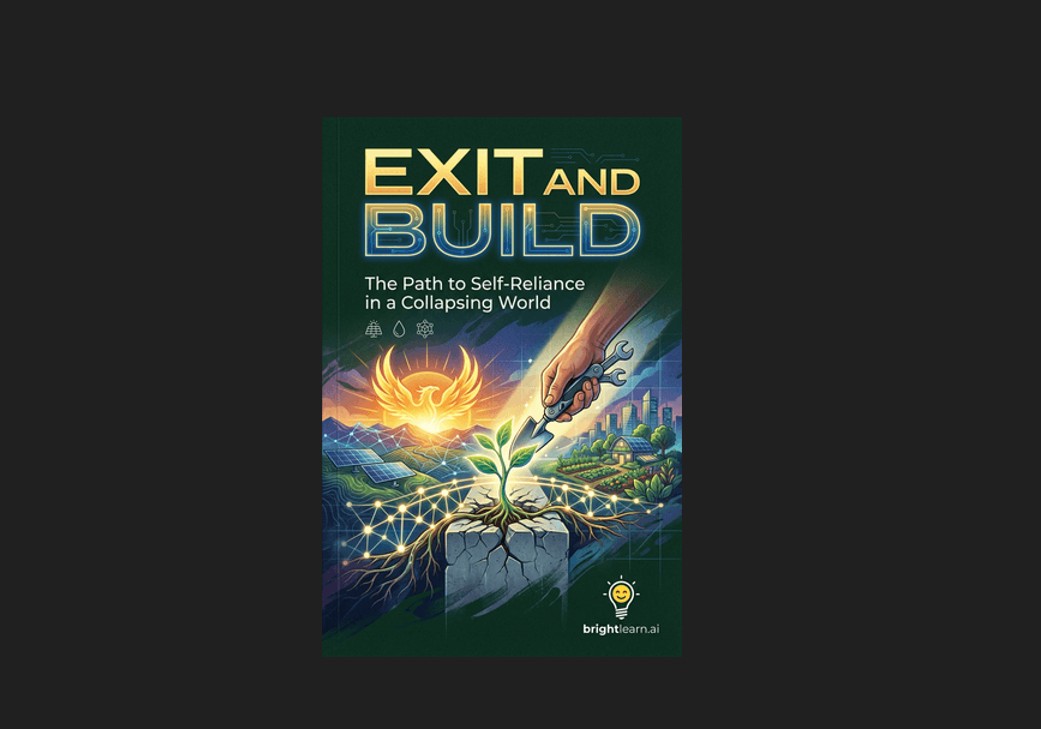
- "Exit and Build" draws parallels between modern society and the fall of Rome, citing economic instability, political corruption and digital surveillance as accelerating decline. The solution? Exit broken systems and build resilient alternatives.
- Unlike industrial farming (dependent on chemicals and GMOs), regenerative methods (rotational grazing, no-till farming) heal the land while producing nutrient-dense food. Pioneers like Joel Salatin prove small-scale farming can outproduce Big Agra sustainably.
- The book highlights off-grid, self-sufficiency and practical strategies for: water security (rainwater harvesting, natural purification), energy independence (solar, wind, micro-hydro systems), natural shelter (cob, straw bale homes to escape toxic mortgages) and decentralization = freedom from failing systems.
- Survival depends on tribal networks—groups built on mutual aid, barter economies and shared values. Examples like the Beacon Hill Food Forest show local cooperation outlasts top-down control.
- Overcoming societal brainwashing (dependency on pharmaceuticals, processed foods, fiat currency) requires: cognitive reframing (collapse as opportunity), stoic resilience (focus on controllables) and OODA loop (observe, orient, decide, act for rapid adaptation).
In a world teetering on the edge of systemic collapse—where centralized institutions, corporate greed and government overreach threaten individual freedoms—"Exit and Build" emerges as a rallying cry for those seeking true independence. This isn't just a survival manual; it's a manifesto for reclaiming sovereignty over your food, health, finances and community.
The book opens with a sobering truth: civilizations rise and fall and ours is no exception. Drawing parallels to the fall of Rome—where economic instability, political corruption and social decay led to collapse—the authors highlight how modern parallels like inflation, supply chain disruptions and digital surveillance are accelerating our own decline. The solution? Exit the broken systems and build resilient alternatives.
From rigged elections to toxic pharmaceuticals, the book doesn't shy away from exposing the corruption embedded in centralized power structures. But rather than fostering despair, it offers a roadmap for liberation.
Regenerative living: Healing the land and ourselves
One of the book's most compelling sections dives into regenerative agriculture—a practice that heals degraded soil while producing nutrient-dense food. Unlike industrial farming, which relies on chemical inputs and GMOs, regenerative methods mimic nature's wisdom. Think rotational grazing, no-till farming and polycultures that rebuild ecosystems.
The authors spotlight pioneers like Joel Salatin, whose Polyface Farm proves that small-scale, ethical farming can outproduce industrial agribusiness—without poisoning the land or consumers. This isn't just about growing food; it's about reclaiming control from Big Agra and its government enablers.
Water scarcity, power outages and housing crises are no longer hypotheticals—they're realities. "Exit and Build" provides actionable strategies for:
- Water security: Harvesting rainwater, building swales and purifying water without relying on municipal systems (which are increasingly weaponized).
- Energy independence: Solar, wind and micro-hydro systems that break dependence on a grid vulnerable to cyberattacks and blackouts.
- Natural building: Cob, straw bale and earthbag homes that sidestep bank mortgages and toxic construction materials.
The message is clear: Decentralize or remain at the mercy of failing systems.
Community over collapse: The power of tribal networks
Isolation is a death sentence in collapse scenarios. The book emphasizes intentional communities—groups united by shared values of liberty, mutual aid and self-sufficiency. From barter economies to skill-sharing networks, these micro-societies are the antidote to the alienation of modern life.
Case studies like the Beacon Hill Food Forest and the Zapatista autonomous zones prove that local cooperation can outlast top-down control. The key? Trust, transparency and a commitment to opt out of dependency.
The greatest barrier to self-reliance isn't lack of resources—it's psychological conditioning. The book tackles societal brainwashing (e.g., reliance on pharmaceuticals, processed foods and fiat currency) and offers tools for mental resilience:
- Cognitive reframing: View collapse as an opportunity, not doom.
- Stoic practices: Focus on what you can control.
- OODA loop: Observe, orient, decide, act—a military strategy for rapid adaptation.
"Exit and Build" isn't just a book—it's a movement. Whether you're planting a backyard garden, joining a local mutual aid group or ditching CBDCs for cryptocurrency, the message is the same: The time to act is now.
For those tired of waiting for corrupt institutions to "fix" problems they created, this book is your blueprint. As the authors remind us: "Freedom isn't given. It's taken—by those willing to plant seeds, both literal and metaphorical, in the soil of a new world."
Grab a copy of "Exit and Build: The Path to Self-Reliance in a Collapsing World" via this link. Read, share and download thousands of books for free at Books.BrightLearn.AI. You can also create your own books for free at BrightLearn.AI.
Watch the "Health Ranger Report" episode below. where John Bush joins Mike Adams for a knowledge-packed conversation on exiting the control grid and expanding self-reliance.
This video is from the Health Ranger Report channel on Brighteon.com.
Sources include:










Please contact us for more information.