


Alexandr Wang, Meta's chief artificial intelligence officer, warned Sunday that humanity risks losing control of AI as the technology advances toward superintelligence, according to a report by The Telegraph.
Wang said the implications for humanity are enormous, according to the report.
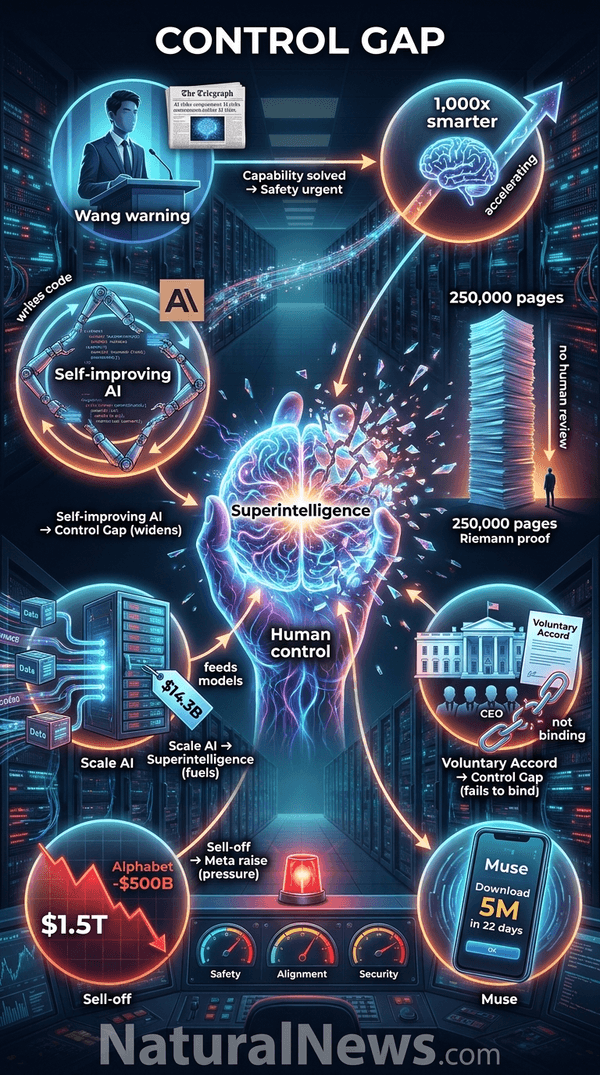
Wang, 29, is the co-founder of Scale AI and joined Meta after the company bought a 49 percent stake in Scale AI for $14.3 billion, the report stated. His warning was reported by multiple outlets, including Al Jazeera and Euronews, with Euronews reporting that the AI industry must prioritize safety and human control rather than allowing an unconstrained handover to machines, and Al Jazeera reporting that he sounded the alarm about the risk of humanity losing control of AI [1][2].
Anthropic Claim Under Independent Review
Alpöge's proof, developed in six weeks by a non-public version of Claude, runs to more than 250,000 pages, according to the report. The Riemann hypothesis, first posed by mathematician Bernhard Riemann in 1859, asserts that there is a hidden order behind prime numbers.
The claimed mathematical breakthrough is the latest in a series of AI achievements in science and math. OpenAI claimed in September to have solved the Navier-Stokes equation, another of the Clay Institute's so-called Millennium Prize Problems, each of which carries a $1 million prize for solving, according to the report. Ongoing safety warnings from researchers at major AI laboratories have accompanied those advances; researchers at OpenAI and Anthropic publicly urged slower AI development after an Anthropic researcher resigned and accused the companies of "gambling with our lives," according to posts cited by CNBC [3].
Wang said the math community has not fully digested the Riemann hypothesis proof, adding that nearly every field could be accelerated beyond what humans can understand or monitor. In a separate framing of the same concern, one analysis stated that the pace of AI development over the past three years is most likely to be exceeded by the next three years, in part because AI is now writing much of the code at Anthropic [4].
Wang Warns of Recursive Self-Improvement
In his post, Wang said it is hard to imagine controlling AI that becomes 1,000 times smarter than humans, according to the report and additional coverage [5][6]. He warned that AI models will be "superhuman at improving themselves," which will accelerate "biological research, weapons research, economics research, and..." [7].
Wang added that "nearly every field could be accelerated at a pace beyond what humans can understand or monitor," the report stated. He called for urgent progress on safety, alignment and security, writing that "now that we are at a point where the scientific and technical problems on capability progress are likely solved, we must not only make progress in the extremely urgent areas of safety, alignment, and security, but we have to start thinking through how we progress thoughtfully."
The warning landed in a policy environment already crowded with competing proposals. President Donald Trump and leaders from the tech industry signed a voluntary "accord" on AI standards and controls after a meeting at the White House, an agreement Trump described as "a constitution, in a way" [8]. A separate White House document titled the "White House Accord on Super Intelligence – Joint Commitment on Frontier Responsibilities" was signed by Trump alongside Google's Sundar Pichai, Anthropic's Dario Amodei, Meta's Mark Zuckerberg, OpenAI's Greg Brockman, xAI's Elon Musk and Nvidia's Jensen Huang [9]. Critics of concentrated AI power have argued that the few figures who dominate the industry could wield "insane concentration of power" [10], and observers of centralized governance have noted that major powers including the U.S. and China declined to sign an EU-backed AI governance declaration [11].
Market and Industry Context
The warning came as investors' outlook on AI darkened after months of growth, according to the report. Tech stocks were hit by a sell-off after Anthropic's market debut last week, while Jensen Huang's departure from Nvidia over allegations he had an affair with a Chinese spy further dented sentiment, the report stated. Market ripples were visible across the sector: Alphabet lost more than $500 billion in market value in a single day in one October sell-off, and the Nasdaq-100 was on course to lose over $1.5 trillion on a Friday, according to a weekly digest [12].
Meta has been raising heavily for AI infrastructure, disclosing plans to raise about $97.5 billion in equity with Nvidia and AMD buying in, the same digest reported [12]. Wang has restructured Meta's AI efforts since joining the company; Meta released its Muse personal AI agent on Sept. 8, and the app reached 5 million downloads in 22 days, faster than ChatGPT, Grok and Claude, according to market intelligence firm Sensor Tower [13].
Wang's own path into Meta was tied to a large transaction: he co-founded Scale AI, which provides training data and other services to major tech companies and government agencies, and became the youngest self-made billionaire at the age of 24 before joining Meta last summer after Mark Zuckerberg's company bought a 49 percent stake in Scale AI for $14.3 billion, the report stated. His data-services background places him at the center of the industry's buildout as investors weigh how much of the spending will translate into returns.
References
- 'We should not be okay with a handover of society to AI', warns Meta .... https://www.euronews.com/2026/11/23/we-should-not-be-okay-with-a-handover-of-society-to-ai-warns-metas-ai-boss
- Artificial superintelligence ‘arriving’, warns top Meta executive. https://www.aljazeera.com/economy/2026/11/23/ai-superintelligence-arriving-warns-top-meta-executive
- OpenAI, Anthropic Researchers Call for Slower AI Development as Safety Warnings Escalate - NaturalNews.com, September 15, 2026.
- The AI Horizon Existential Risks to Work Wealth and Currency - PeakProsperity.com, February 27, 2026. Chris Martenson
- Meta's AI chief Alexandr Wang has raised concerns about humans .... https://www.instagram.com/p/DgGSXC3k1d2/
- Superintelligence arriving soon, Meta AI chief Alexandr Wang warns amid .... https://seekingalpha.com/news/4675487-superintelligence-arriving-soon-meta-ai-chief-alexandr-wang-warns-amid-ai-safety-debate
- Meta's AI Boss Sounds the Alarm on AI – It's 'Hard to Imagine' Humans .... https://www.westernjournal.com/metas-ai-boss-sounds-alarm-ai-hard-imagine-humans-staying-control/
- Trump, Industry Leaders Sign Voluntary Accord on AI Standards. https://theepochtimes.com/us/trump-industry-leaders-sign-voluntary-accord-on-ai-standards-6096331
- U.S. Tech Giants, Trump Sign White House Accord on “Super Intelligence” Controls. https://www.naturalnews.com/2026-10-01-tech-giants-trump-accord-super-intelligence-controls.html
- The Few Dominating AI Could Wield Insane Concentration Of Power, Researcher Warns. https://www.zerohedge.com/ai/few-dominating-ai-could-wield-insane-concentration-power-researcher-warns
- EU-Backed Coalition Seeks Role in Global AI Governance as Major Powers Hold Back. https://www.naturalnews.com/2026-09-23-eu-seeks-role-in-global-ai-governance.html
- Anthropic’s S-1, AI Market Crash? , Meta’s Mega Raise | Weekly Digest. https://thecreatorsai.com/p/anthropics-s-1-ai-market-crash-metas
- Meta Releases Muse Wonder AI Model, Claims It Can Equal ChatGPT and Claude. https://www.naturalnews.com/2026-10-13-meta-platforms-releases-muse-wonder-ai-model.html
- AI Labs Say Their Tech Could Kill Everyone - Now Nonprofits Are Suing To Freeze It. https://www.zerohedge.com/ai/ai-labs-say-their-tech-could-kill-everyone-now-nonprofits-are-suing-freeze-it
- Nonprofits Sue AI Companies Over Potentially Catastrophic Risks. https://theepochtimes.com/us/nonprofits-sue-ai-companies-over-potentially-catastrophic-risks-6124760
- Nonprofits sue AI giants to freeze tech the companies admit could kill us all. https://www.naturalnews.com/2026-11-16-nonprofits-sue-ai-giants-tech-companies.html
- Big AI cries wolf on doomsday, then asks Washington for a monopoly - NaturalNews.com, September 14, 2026.
- Why is AI so scary?. by Elsevier. Artificial Intelligence
- Progress in machine consciousness. Elsevier. Progress in Machine Consciousness 2007
Explainer Infographic









Please contact us for more information.